Do not hesitage to give us a call. We are an expert team and we are happy to talk to you.
1.8445.3356.33
Help@goodlayers.com
Twelve days to go right round Morocco: the four imperial cities, the High and Middle Atlas, the Merzouga desert, the southern valleys and the Atlantic coast.
It is the most complete circuit we run by road, with double nights in the bigger cities so the trip is not spent packing and unpacking.
Pick-up at your riad or hotel in Marrakech, or at its airport. We return you to the same point.
Twelve days with double nights in Fez, Marrakech and the desert region. No single stage runs beyond about five hours.
We collect you and spend the day in Marrakech: the Koutoubia with its twelfth century minaret, the Bahia palace with its courtyards and painted ceilings, and the Saadian tombs.
In the afternoon the souks of the medina, organised by trade, and the Majorelle garden if you would rather something quieter.
At dusk we leave you at Jemaa el Fna, which changes completely once the food stalls go up and the musicians come out.
Dinner and overnight in a riad in the medina.
North on the motorway to Casablanca, where we visit the Hassan II mosque, the only one in the country non-Muslims may enter. It is built partly over the water and its minaret, at two hundred and ten metres, is the tallest in the world.
A walk through the Habous quarter, the new medina the French laid out in the 1930s, then on up the coast.
In Rabat we see the Hassan Tower, the unfinished minaret of a twelfth century mosque, the Mohammed V mausoleum opposite, and the Kasbah des Oudayas, a walled quarter of blue and white houses above the mouth of the Bou Regreg.
Dinner and overnight in Rabat.
We head inland to Meknes, the imperial city of Moulay Ismail, ringed by forty kilometres of wall. We see Bab Mansour, the most worked gate in Morocco, the El Hedim square and the vaulted royal granaries built to feed twelve thousand horses.
Then Volubilis, the best preserved Roman city in the country and a UNESCO site: the arch of Caracalla, the capitol, the basilica and above all the mosaics, still in the floors of the houses where they were laid.
A stop at Moulay Idriss Zerhoun, the holy town of white houses climbing two hills around the tomb of the founder of the first Moroccan dynasty.
We reach Fez in the evening. Dinner and overnight in a riad in the medina.
We collect you and give the whole day to the medina, on foot. Fez el Bali is the largest car-free urban area in the world: around nine thousand lanes where everything still moves by foot or by donkey.
We see the Bou Inania madrasa, from the fourteenth century, with its carved cedar and plasterwork, and the courtyard of the Al Qarawiyyin university, founded in 859 and considered the oldest continuously operating university anywhere.
We climb to the terraces of the leather workshops to look down on the Chouara tanneries, with their lime and natural dye pits, a system that has barely changed in a thousand years.
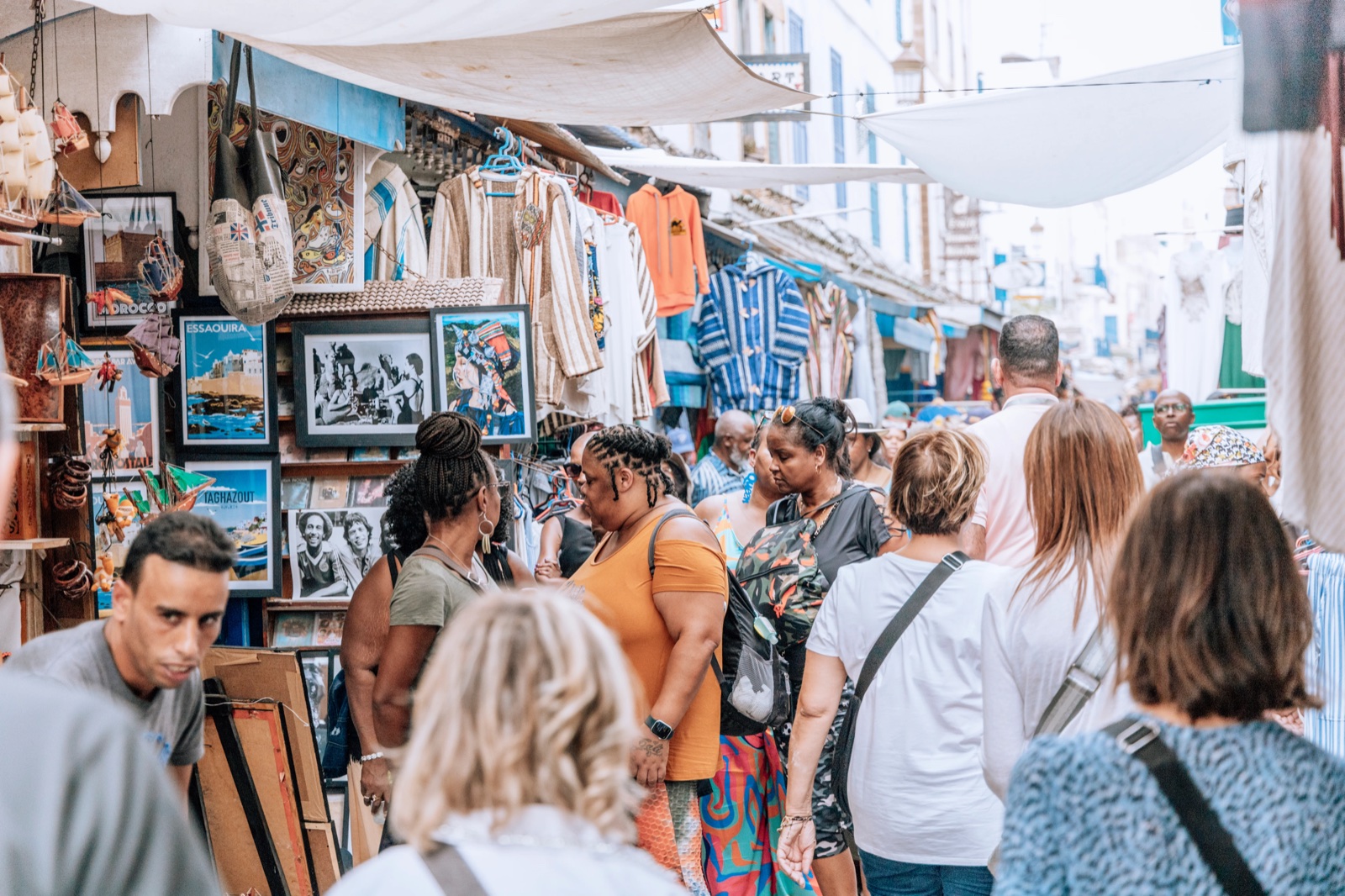
The rest of the day is for the souks, organised by guild since the Middle Ages: coppersmiths, dyers, cabinetmakers, the spice market. Dinner and overnight in a riad in the medina.
We head south and within an hour the landscape changes completely. We stop at Ifrane, the mountain town of pitched roofs the French built in the 1930s, and at the cedar forest of Azrou, where Barbary macaques gather by the Gouraud Cedar.
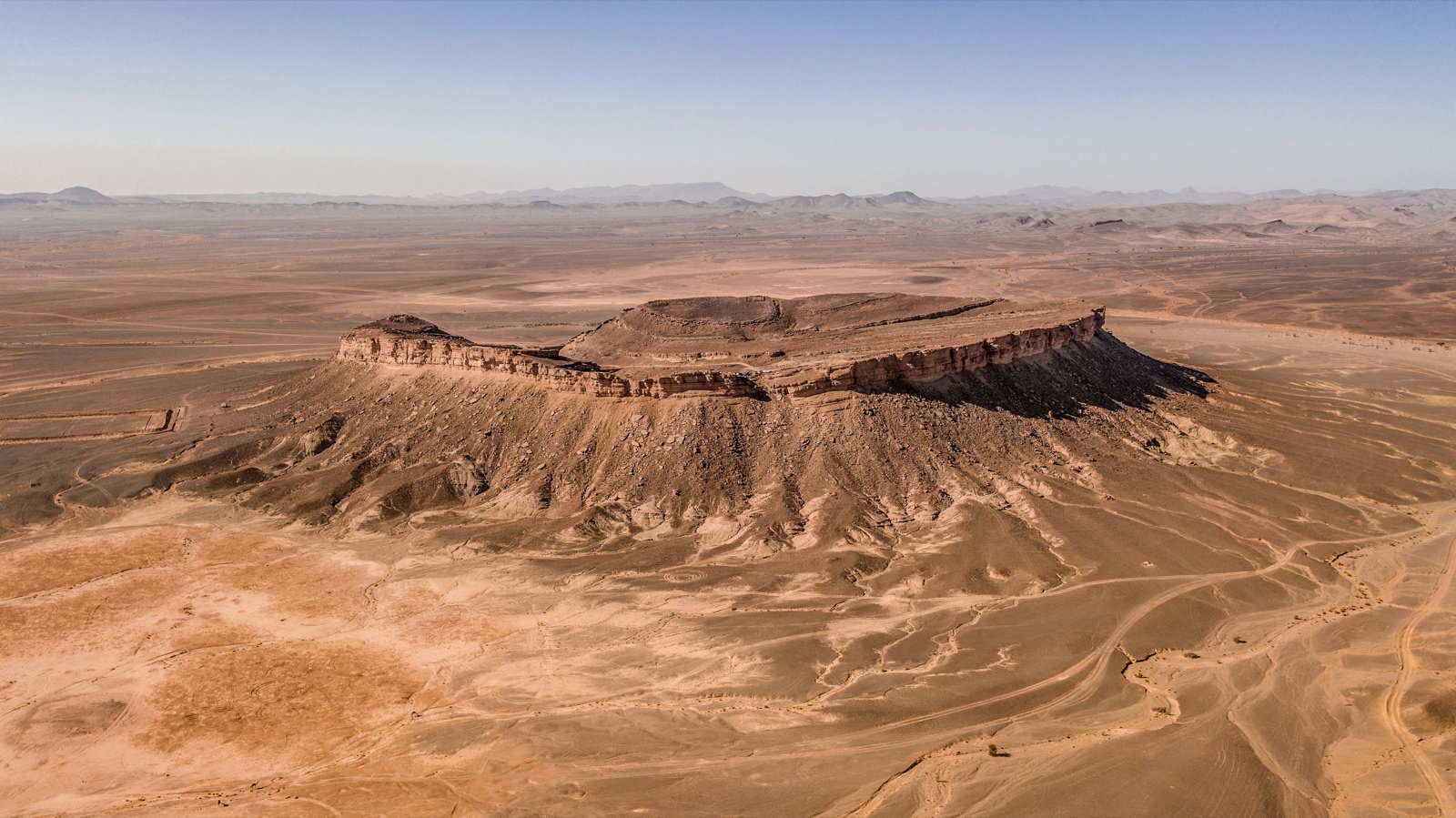
We cross the Middle Atlas at Midelt, in the corridor between the two ranges, and from there the vegetation gives out and the stony plateaux begin.
The last stretch runs down the Ziz valley, a palm grove tens of kilometres long wedged between red walls, with a viewpoint where the river and the palms run out of sight. Dinner and overnight in the Erfoud area.
We start in Erfoud, capital of the fossil trade, then Rissani, built over the ruins of Sijilmasa, from which the gold caravans left for Timbuktu. The souk runs on Sundays, Tuesdays and Thursdays and is still a working local market. We eat medfouna, the stuffed flatbread baked under hot sand.
In the afternoon we move towards Merzouga and, depending on the season, out to Dayet Srji, the seasonal lake where flamingos stop in spring, or to Khamlia, where gnawa music is played live.
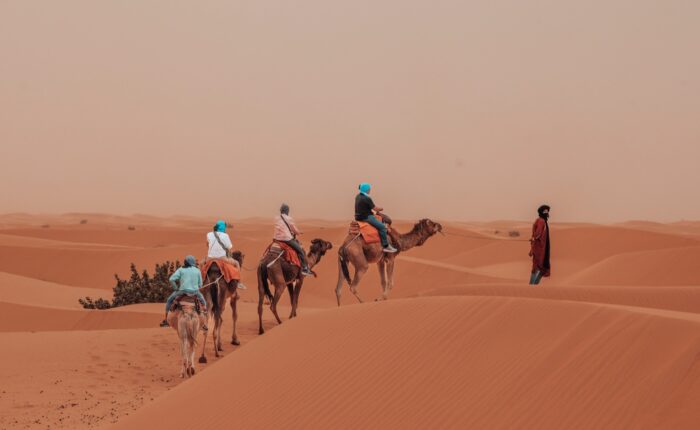
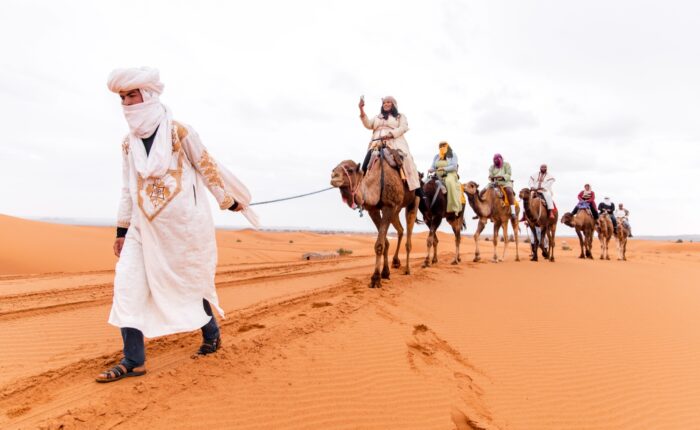
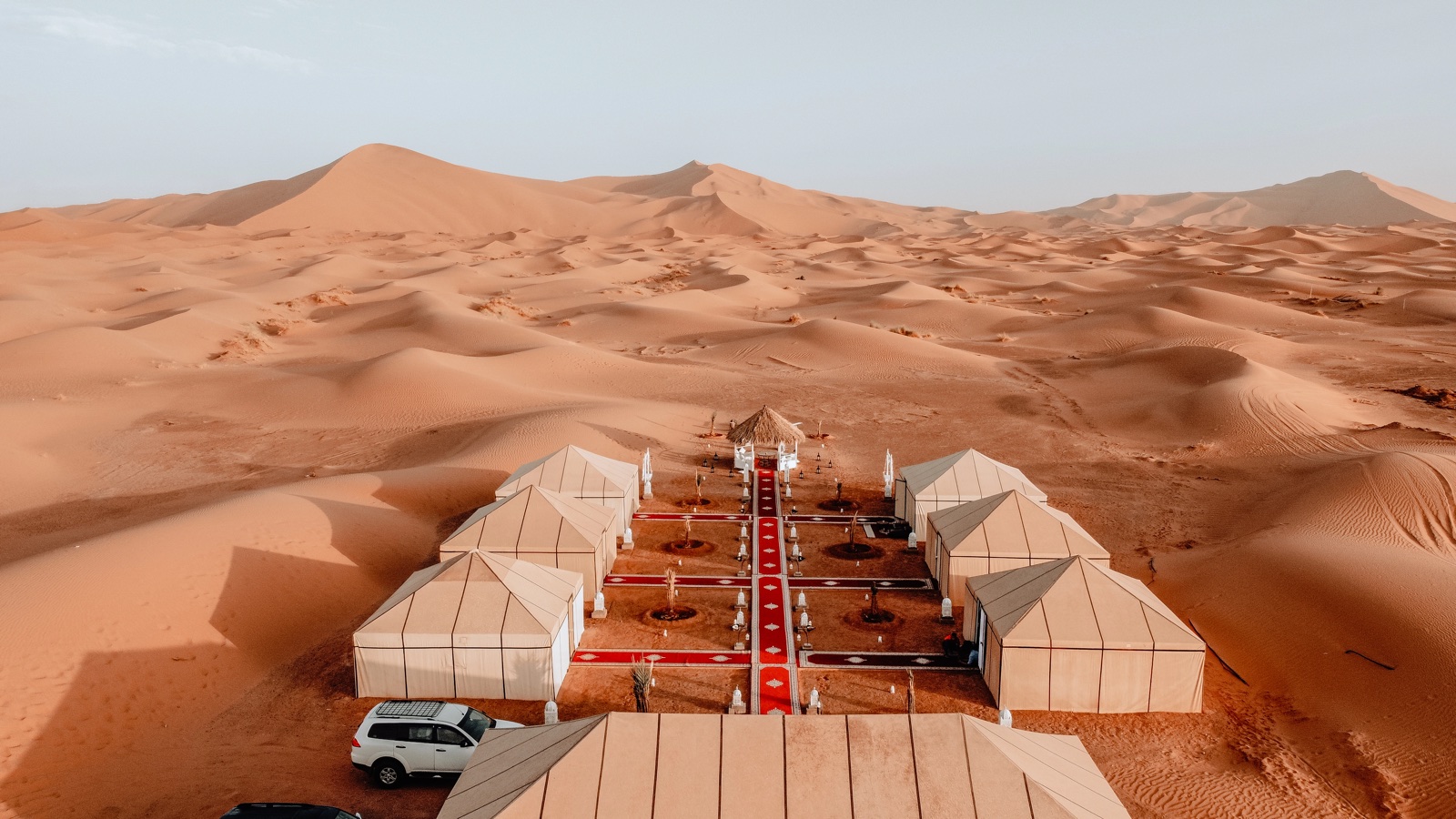
As the light drops we swap the car for a camel and ride into Erg Chebbi, dunes reaching 150 metres. An hour and a half in caravan brings us to the camp, with time to climb a dune for sunset. Berber dinner, drums by the fire and a night in a tent.
Up before dawn for sunrise over the erg, the sand shifting from grey to orange within minutes. We ride back to the village and have breakfast at the hotel, with time to shower and rest.
No long road today. Depending on the season we go out to Dayet Srji, and we visit Khamlia, the village founded by descendants of sub-Saharan populations where gnawa music is played live in the afternoons.
We can stop for tea at a nomad camp, or drive out to the abandoned mine workings at Mifis and the line where the sand meets the flat stony hamada.
If you want more, the afternoon takes a 4×4 run across the erg or an hour on a quad. Second night in the Merzouga area, hotel or camp as you prefer.
We head west through Tinghir, a long narrow oasis of palms between bare mountains, with a walk through the palm grove and the old adobe ksar above it.
We go into the Todra gorges: 300 metres of vertical wall narrowing to about ten metres, with the river running along the floor. We walk inside in the shade, usually with climbers on the routes overhead.
In the afternoon we drive up the Dades canyon, with its zigzag bends and the eroded rock formations people here call monkey fingers.
Dinner and overnight in the Dades valley or near the Todra, depending on the stage.
We take the Road of a Thousand Kasbahs west, stopping in the rose valley at Kelaat M Gouna, where Damascus roses have been grown for centuries and rose water is distilled in the village cooperatives.
On to the Skoura palm grove, a dense oasis hiding some of the best preserved kasbahs in the south, Amridil among them, the one that appears on the fifty dirham note.
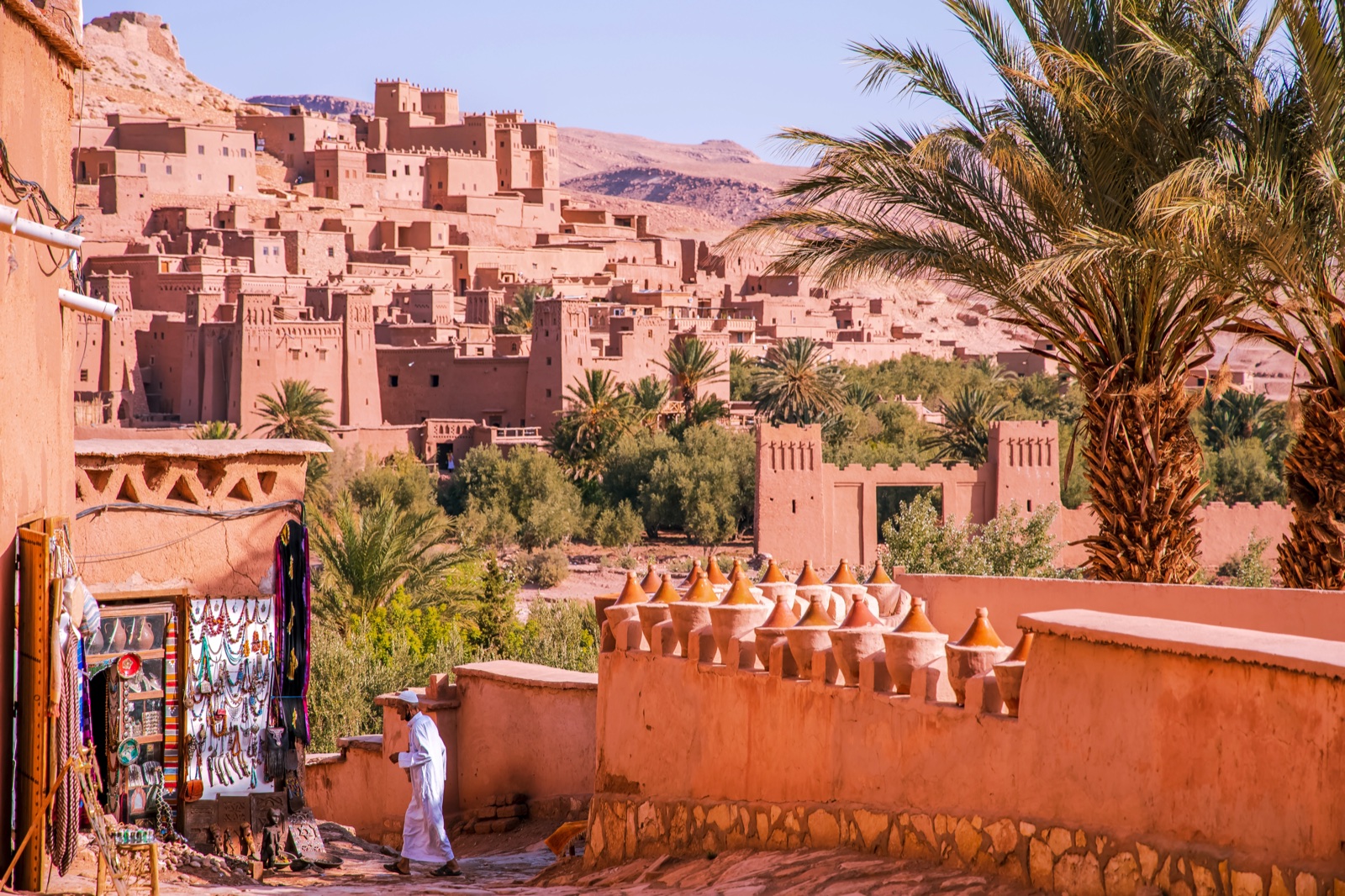
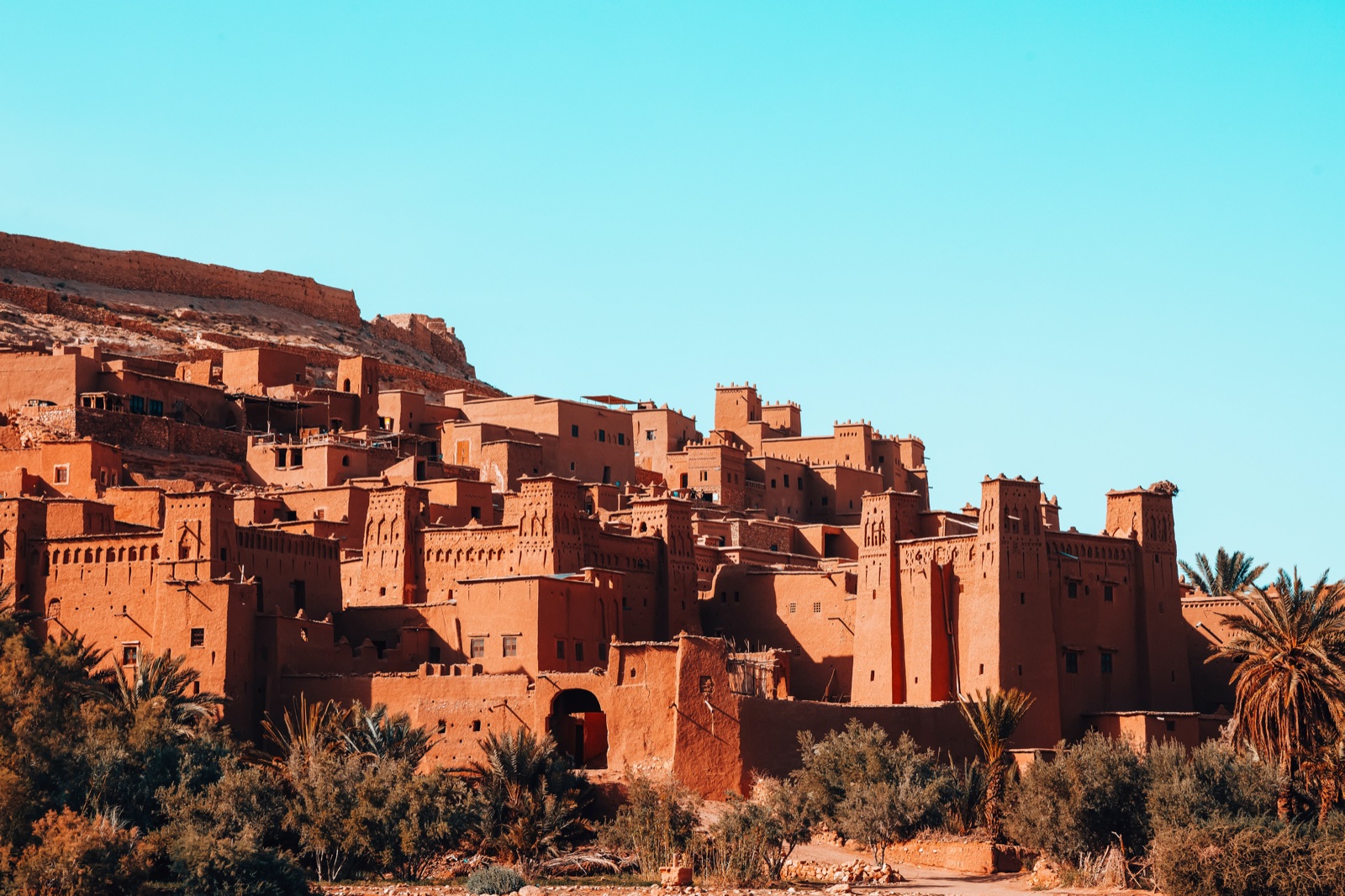
We pass Ouarzazate, with the Taourirt kasbah and the film studios, and reach Ait Ben Haddou with the low afternoon light, which is when the ksar looks its best. We cross the Ounila river and climb to the granary at the top.
Dinner and overnight near the kasbah or in Ouarzazate.
We cross the High Atlas by the Tizi n Tichka at 2,260 metres, with a last stop at the viewpoints, and drop to the Marrakech plain.
Rather than stopping we carry on west towards the Atlantic, through argan country. We stop at a womens argan cooperative, where the nuts are cracked and pressed by hand, and on the stretch where goats climb the argan trees.
We reach Essaouira in the late afternoon: wind, gulls and Portuguese ramparts facing the ocean.
Dinner and overnight inside the walls.
A full day in Essaouira, which is small enough to cover on foot. The medina is a UNESCO site, laid out on a grid rather than the tangle of the inland cities.
We walk the ramparts, the Skala with its old cannons, the thuya woodworking shops and the spice souk.
Lunch at the fishing harbour, where the blue boats land their catch and the grills are set up along the quay.
Free afternoon for the beach, which runs for kilometres and is usually windy enough for kitesurfers. Second night in Essaouira.
A relaxed final morning in Essaouira, with time for the ramparts at first light or a last walk through the medina.
We drive back inland, about two and a half hours across the plain, with a stop if you want one.
We reach Marrakech at midday or early afternoon.
We leave you at your riad or at the airport, with margin for a flight the same day.